DENCANTO COMMUNITY · LEARNING SPANISH FAST
Do you want to learn Spanish fast and start speaking confidently in real-life situations? The key is not memorizing hundreds of grammar rules or studying for hours without a break. To make real progress, you need to combine useful vocabulary, active practice, listening comprehension, and conversation from the very beginning.
If you can also spend some time living in Spain, learning becomes much more practical: ordering a coffee, asking for directions, doing the shopping, or having a conversation with other people all become opportunities to use the language.
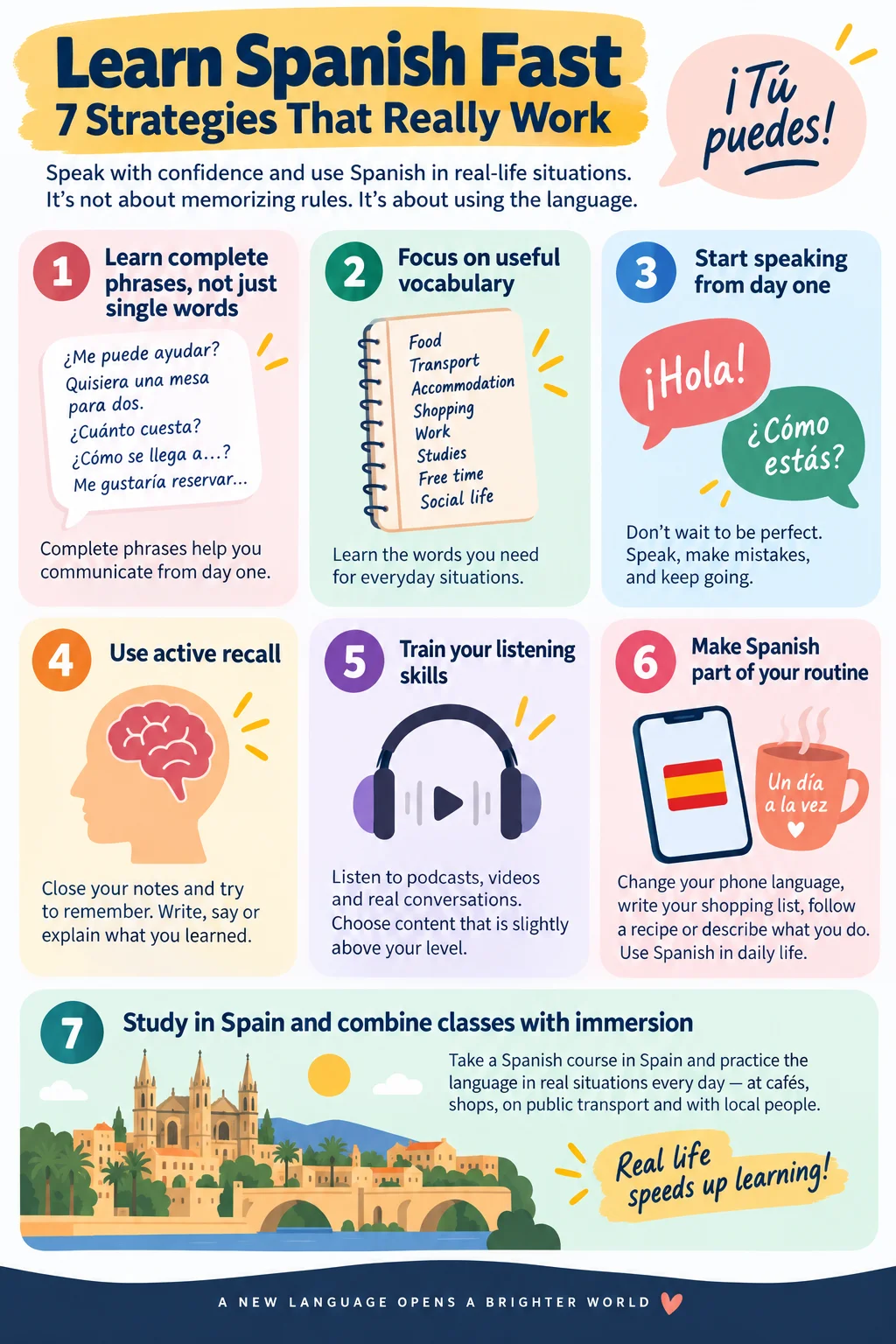
These are 7 strategies for learning Spanish fast and effectively.
01 / STRATEGY
Learn complete phrases, not just words
Memorizing endless vocabulary lists may help you recognize words, but it does not necessarily help you use them when speaking.
It is more useful to learn complete expressions that you can reuse in different situations:
Mini glossary: complete expressions
- “Can you help me?”
- “I would like a table for two.”
- “How much does it cost?”
- “How do I get to…?”
- “I would like to book…”
This type of structure allows you to start communicating even when you do not yet master all the grammar.
02 / STRATEGY
Prioritize the vocabulary you actually need
You do not need to know thousands of words to start getting by in Spanish.
Start with vocabulary related to your daily life: food, transport, accommodation, shopping, work, studies, free time, and social conversations.
A good strategy is to create small groups of words based on specific situations. This makes them much easier to remember and use when you really need them. If your goal is to study, work, or take a certification exam, adapt the vocabulary to that goal. You can also explore official Spanish exam courses if you need to certify your level.
03 / STRATEGY
Speak Spanish from day one
One of the most common mistakes is waiting until you “know enough” before you start speaking. You do not need to build perfect sentences. You need to dare to produce the language.
You can start by talking to yourself, describing what you do during the day, or simulating conversations. Then look for opportunities to speak with teachers, classmates, friends, or local people. Mistakes are part of the process. If you wait until you master grammar before speaking, you will delay the very skill you want to develop.
04 / STRATEGY
Practice active recall
Reading a vocabulary list several times does not necessarily mean you can remember it when you need to speak. Instead of rereading your notes, try to retrieve the information from memory.
For example, after a class, close your notebook and write down everything you remember. You can also try explaining in Spanish what you have learned or reconstructing a conversation you had during the day.
Active recall actions:
- Retrieve information from memory
- Close your notebook
- Write down everything you remember
- Explain in Spanish what you have learned
- Reconstruct a conversation
This practice forces your brain to actively retrieve the words and structures you want to learn.
05 / STRATEGY
Train your ear with Spanish you can understand
To speak better, you need to listen to Spanish often. Podcasts, videos, conversations, and series can help you get used to different accents, speeds, and ways of expressing yourself.
The key is to choose content that is slightly above your level but that you can understand from context. If you do not understand anything at all, it will be difficult to benefit from it. A good routine can be to listen for a few minutes every day and repeat some phrases out loud, imitating pronunciation and intonation.

06 / STRATEGY
Make Spanish part of your routine
Learning Spanish does not have to mean sitting in front of a book for hours. You can change the language on your phone, write a shopping list in Spanish, keep a small journal, follow a recipe, or mentally describe what you are doing. If you are in Spain, it is even easier to turn everyday activities into language practice. Instead of just attending class, try to use Spanish when you go to a café, use public transport, do some shopping, or meet other people.
Spanish in your routine:
- Change your phone language
- Shopping list
- Journal
- Recipe
- Café
- Public transport
07 / STRATEGY
Study in Spain and combine classes with immersion
If you want to speed up your learning, studying Spanish in Spain can make a big difference because it allows you to combine classes with real situations throughout the day.
An interesting option is to take an intensive Spanish course and use the rest of the day to practice. This way, what you learn in the morning can appear again in the afternoon in a conversation, an activity, or an everyday situation.
Intensity should also adapt to you. If you have little time, an intensive course can help you make the most of your stay. If you prefer to have more free time, a semi-intensive course can be a more comfortable alternative.
To find an experience that matches your goals, dates, and preferences, you can learn more about Dencanto Community and how we help you find your Spanish experience in Spain.
08 / TIME
How long does it take to learn Spanish?
There is no number of days or weeks that guarantees someone will speak Spanish fluently. Progress depends on your starting level, how often you study, how much you practice, and how much contact you have with the language.
The important thing is to create a system you can maintain:
Classes + active practice + conversation + exposure to Spanish + real-life situations.
One hour of daily practice and frequent conversation can be more useful than studying many hours passively once a week.
09 / FIRST STEPS
How do you start learning Spanish faster?
If you want to start from scratch or pick the language back up after some time away, first identify your level and define why you need Spanish. Then choose a course format you can maintain and look for opportunities to speak from day one.
If you are not sure what your current level is, you can take our online Spanish level test. It will help you get oriented before choosing a course and identify which areas you need to work on.
At Dencanto Community you can find courses and Spanish schools in different destinations in Spain and receive guidance to choose an experience adapted to your goals. You can choose intensive courses, semi-intensive courses, or private classes depending on how much time you have and how quickly you want to progress.
Because learning Spanish fast does not mean studying nonstop. It means making better use of every moment when you can listen, understand, and use the language.
10 / FREQUENTLY ASKED QUESTIONS
Frequently asked questions about learning Spanish fast
What is the fastest way to learn Spanish?
The most effective way is to combine structured study with frequent practice. A Spanish course, daily conversation, active listening, and real-life situations allow you to work on different skills at the same time.
Can I learn Spanish fast if I start from scratch?
Yes, although progress will be gradual. If you are a beginner, start with functional vocabulary and expressions, practice everyday situations, and use a course adapted to your level. You do not need to wait until you master grammar to start speaking.
Is it better to study Spanish in Spain?
Studying in Spain lets you combine classes with constant exposure to the language. Everyday situations offer opportunities to practice what you have learned outside the classroom, especially if you interact with other people and make an effort to use Spanish.
How many hours a day should I study Spanish?
It depends on your availability and goals. An intensive course can be suitable for those who want to progress quickly during a short stay, while a semi-intensive format may work better if you want to combine learning with work, tourism, or activities.
What should I do if I understand Spanish but struggle to speak?
Prioritize active production. Speak even if you make mistakes, practice common conversations, repeat phrases out loud, and look for opportunities to talk. Understanding the language and using it spontaneously are different skills and require specific practice.